3. CAPT. ABDUL HAMEED SUBHARTI HOSPITAL, KHAJOORI (RHTC)
4. SARDAR BHAGAT SINGH SUBHARTI URBAN HEALTH TRAINING CENTRE, MULTAN NAGAR (UHTC)
5. LATE DR.VERENDER SHARMA MEMORIAL VIR SVAKAR SUBHARTI HOSPITAL, VILLAGE LOHIA (UHTC).
FACILITIES PROVIDED
The lab facilities for the nursing college according to the Indian Nursing Council encompass a variety of specialized areas, including a Fundamental Nursing lab, Pre-Clinical lab, Community Health Nursing lab, Child Health Nursing Lab, Mental Health Nursing Lab, Obstetrics & Gynaecology nursing Lab, Adult Health Nursing Lab, Computer Lab, Nutrition Lab, AV aids Lab, Each of these facilities is equipped with the necessary equipment, models, and resources as prescribed by the INC, ensuring a comprehensive and practical learning experience for our aspiring nurses.
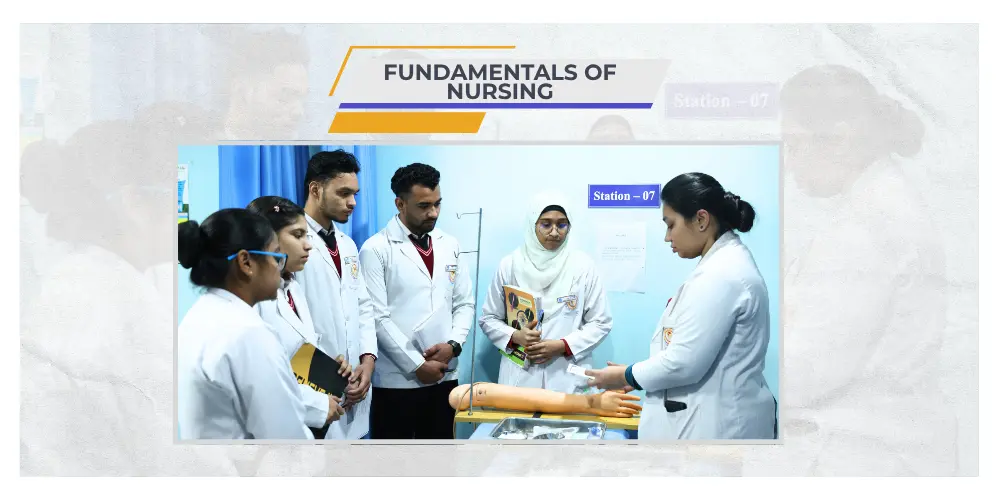
NURSING FOUNDATION
⮚ Name of the lab in charge- Mrs.Lincy (Asst.Prof.) and Mrs. Shaifali Chauhan (PG Tutor)
⮚ Laboratory size: 1458 sq ft
⮚ Lab capacity- 30-40 students
⮚ List of equipment/articles –2500
⮚ No of mannequins/model: 13
LEARNING OUTCOME
To be skilled in Vital signs
To be competent in Medical and Surgical Asepsis
To be skilled in Pain Assessment
To be able in Therapeutic Positions
To learn the Physical Restraints and Side rails
To be skilled in ROM Exercises
ROLES AND RESPONSIBILITIES
Lab In-Charge- oversees lab activities, ensures compliance with SOPs, and maintains equipment.
Faculty in Charge- Guide and supervise students during skill training and assessments. Record each skill teaching session in the lab utilization register.
Students- Each student should carry a log book and checklist during the skill learning session.
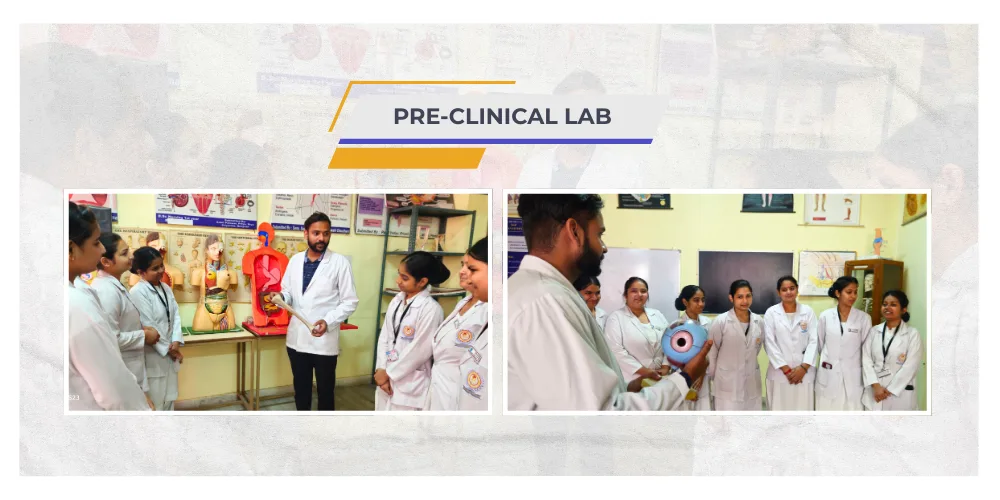
PRE-CLINICAL LAB
⮚ Name of the lab In charge- Mr. Gaurank Pal (PG Tutor)
⮚ Laboratory size: 922.50 sq ft
⮚ lab capacity-30-40students
⮚ No of Equipment/Articles–441
⮚ No of Mannequins/Models: 153
LEARNING OUTCOME:
To develop an understanding of the normal functioning of various body organ systems.
To be skilled in identifying each organ system's relative contribution towards maintaining homeostasis.
To explore the knowledge of the physiological basis to analyse clinical situations and therapeutic applications.
ROLES AND RESPONSIBILITIES:
Lab-In-Charge- Oversees lab activities, ensures compliance with SOPs, and maintains equipment.
Faculty-in-Charge- Guide and supervise students during skill training and assessments. Record each skill teaching session in the lab utilisation register.
Students- Each student should carry a logbook and a checklist during the skill learning session.
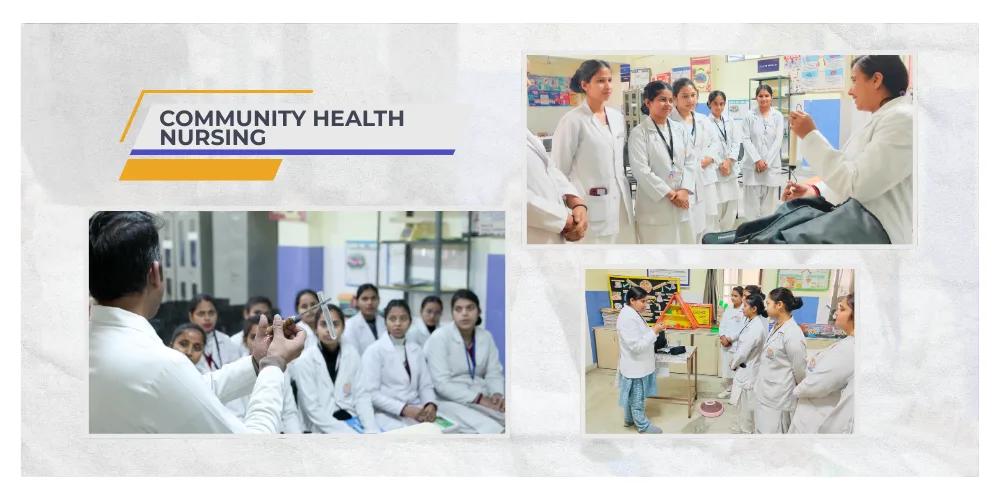
COMMUNITY HEALTH NURSING
⮚ Name of the lab in-charge- Mrs. Khusboo (Asso.Prof.) & Mrs. Archana (Asst. Lect.)
⮚ Laboratory size: 1212 Sq. ft.
⮚ Lab capacity- 50-60 students
⮚ No of Equipment/Articles – 2300
⮚ No of Model: 20
LEARNING OBJECTIVES
Students will learn how to provide comprehensive care for individuals, families, and communities.
Students will learn how to perform home nursing procedures
Students will be competent in Planning health education.
Students will learn to plan and provide health teachings to individuals and families.
Students will be able to conduct public awareness initiatives.
Students will be skilled the counselling and educating individuals, families and communities
Students will learn to conduct a community assessment and diagnosis
Students will identify the high-risk groups in the community and also the risk factors.
ROLES AND RESPONSIBILITIES:
Lab-In-Charge- Oversees lab activities, ensures compliance with SOPs, and maintains equipment.
Faculty-in-Charge- Guide and supervise students during skill training and assessments. Record each skill teaching session in the lab utilisation register.
Students- Each student should carry a logbook and a checklist during the skill learning session.
NUTRITION LAB
⮚ Name of the lab in charge- Mrs. Gunjali (Asst Prof.)
⮚ Laboratory size: 1212 sq ft
⮚ Lab capacity- 50-60 students
⮚ List of equipment/articles – 473
⮚ No of models: 25
LEARNING OUTCOME
Students will have an understanding of Nutritional Science
Students will develop their skills to assess the nutritional status of patients.
Students will learn how to create individualized meal plans that cater to the specific needs of patients based on their health conditions, lifestyles, and preferences.
Students will explore various cultural dietary practices
Students will practice formulating and implementing nutrition interventions and counselling strategies.
Participants will explore diet considerations for specific populations, including children, the elderly, and individuals with chronic illnesses like diabetes, hypertension, and obesity.
ROLES AND RESPONSIBILITIES:
Lab-In-Charge- Oversees lab activities, ensures compliance with SOPs, and maintains equipment.
Faculty-in-Charge- Guide and supervise students during skill training and assessments. Record each skill teaching session in the lab utilisation register.
Students- Each student should carry a logbook and a checklist during the skill learning session.
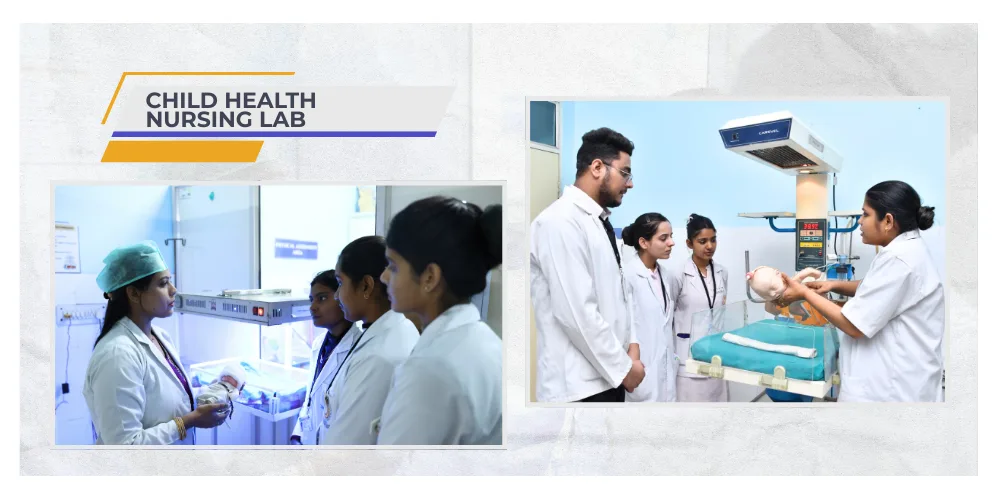
CHILD HEALTH NURSING LAB
⮚ Name of the lab in charge- Mrs. Saroj (Asso. Prof.) & Mrs. Josy (Asst. Prof.)
⮚ Laboratory size: 922.5 Sq ft
⮚ Lab capacity- 30-40 students
⮚ List of equipment/articles –130
⮚ No of mannequins/models: 04
LEARNING OBJECTIVE
To be able the measure the vital signs (temperature, pulse, respiration) in children.
To be competent in conducting anthropometric measurements (weight, height, head circumference).
To be skilled the administering pediatric medications through various routes (oral, IV, IM).
To be able the set up and manage intravenous infusions for pediatric patients.
ROLES AND RESPONSIBILITIES:
Lab-In-Charge- Oversees lab activities, ensures compliance with SOPs, and maintains equipment.
Faculty-in-Charge- Guide and supervise students during skill training and assessments. Record each skill teaching session in the lab utilisation register.
Students- Each student should carry a logbook and a checklist during the skill learning session.
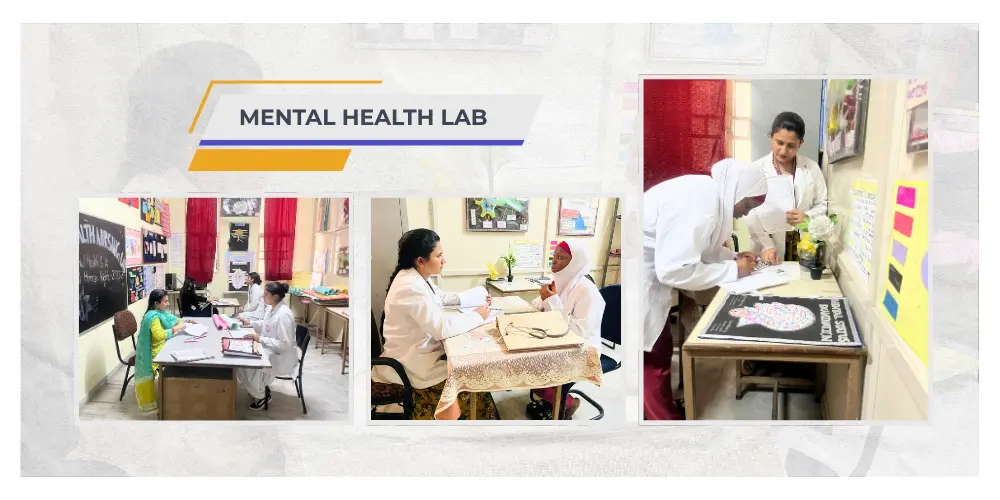
MENTAL HEALTH NURSING
⮚ Name of the lab in charge- Mrs. Priya Bhardwaj (PG Tutor)
⮚ Laboratory size: 922.5 Sq ft
⮚ Lab capacity- 30-40 students
⮚ No of models: 13
LEARNING OBJECTIVE
To gain knowledge assess the patients with mental health problems/disorders.
To be able the Observe and assist various treatment modalities or therapies.
To be competent in Counseling patients and families.
To be able to do individual and group psycho-education.
To learn how to do assessment and care of patients with substance abuse.
ROLES AND RESPONSIBILITIES:
Lab-In-Charge- Oversees lab activities, ensures compliance with SOPs, and maintains equipment.
Faculty-in-Charge- Guide and supervise students during skill training and assessments. Record each skill teaching session in the lab utilisation register.
Students- Each student should carry a logbook and a checklist during the skill learning session.
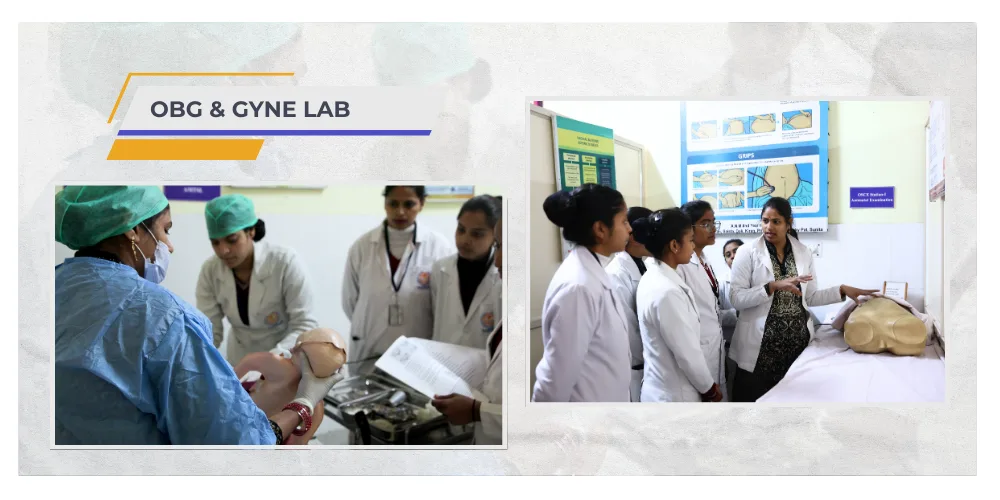
OBG & GYNE LAB
⮚ Name of the lab in charge- Dr. Ambily V (Professor) & Mrs. Komal Saxena (Asst. Prof.)
⮚ Laboratory size: 922.5 Sq ft
⮚ Lab capacity- 30-40 students
⮚ List of equipment/articles – 508
⮚ No of mannequins/models: 13
LEARNING OBJECTIVE
To have Knowledge & ability to perform a Urine pregnancy test.
To be able to calculate the Calculation of EDD, Obstetrical score, gestational weeks.
To be skilled in Antenatal assessment.
To have the ability to provide antenatal mothers' counselling.
To be skilled in performing PV examination.
To have the ability to monitor the first stage of labour and plotting & interpretation of partograph.
To be competent about the Mechanism of normal labour.
To be competent regarding the conduct of normal childbirth with essential newborn care.
ROLES AND RESPONSIBILITIES:
Lab-In-Charge- lab activities, ensures compliance with SOPs, and maintains equipment.
Faculty-in-Charge- Guide and supervise students during skill training and assessments. Record each skill teaching session in the lab utilisation register.
Students- Each student should carry a logbook and a checklist during the skill learning session.
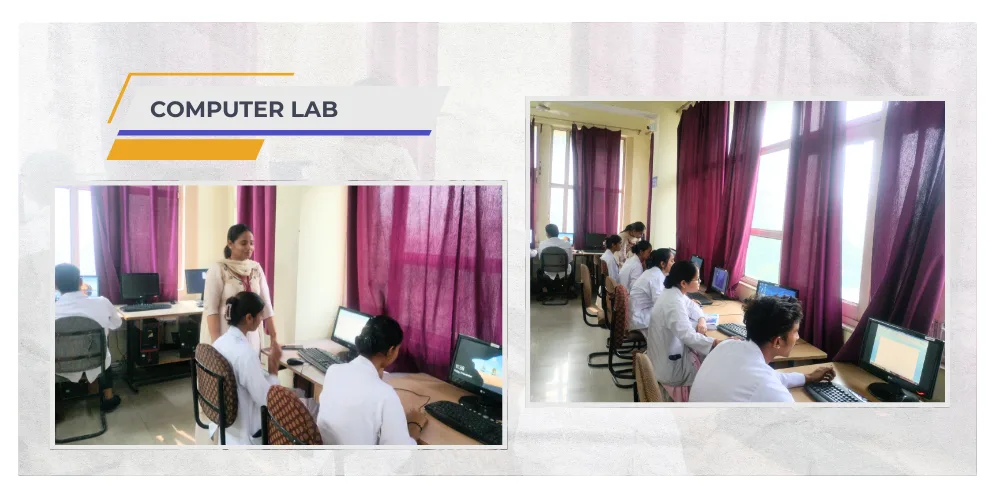
COMPUTER LAB
⮚ Name of the lab in charge- Mr. Deepak
⮚ Lab capacity- 60 students
⮚ Laboratory size: 930 Sq ft
⮚ List of computers- 60
LEARNING OBJECTIVE
Students will gain knowledge of operating systems, file management, and software applications.
Students will Learn about fundamental concepts of networking, internet browsing, and cybersecurity.
To demonstrate proficiency in using productivity tools such as:
Word processing software (e.g., Microsoft Word, Google Docs).
Spreadsheet software (e.g., Microsoft Excel, Google Sheets).
Presentation software (e.g., PowerPoint, Canva).
ROLES AND RESPONSIBILITIES:
The computer lab should be kept clean.
Operate the equipment properly.
Make sure you listen to directions or instructions.
Push your chair in when you are done.
Touch the monitor, keyboard and mouse gently.
Eat and drink outside the computer lab.
The student attendance is maintained by the respective person in charge.
Always bring your library card every time you enter the computer lab.
Bags /handbags are not allowed inside the computer lab.
Please turn off your cell phone or any gadgets that can disturb the class discussion inside the computer lab.
Playing computer games is not allowed inside the computer lab.
Don’t stay inside the computer lab when you have no class.
Don’t steal any computer parts. It is a major offence.
ROLES AND RESPONSIBILITIES:
Lab-In-Charge- Oversees lab activities, ensures compliance with SOPs, and maintains equipment.
Faculty-in-Charge- Guide and supervise students during skill training and assessments. Record each skill teaching session in the lab utilisation register.
Students- Each student should carry a logbook and a checklist during the skill learning session.
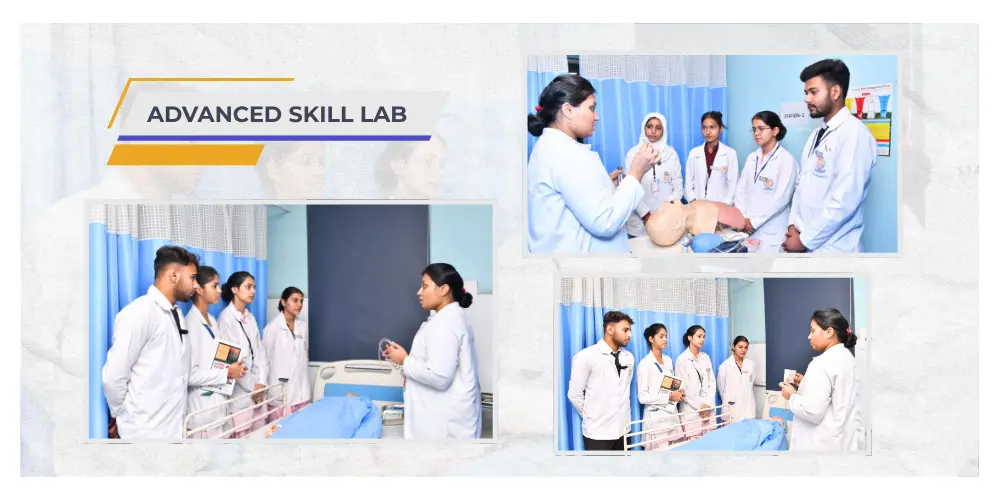
ADVANCED SKILL LABS
⮚ Name of the labs:
1. OBG ADVANCE SKILL LAB
2. ADVANCED ICU SKILL LAB
3. ADULT HEALTH NURSING ALS & BLS SKILL LAB
⮚ Name of the lab in charge- Mrs. Lincy (Asst. Prof.)
⮚ Laboratory size: 1532 Sq ft
⮚ Lab capacity- 30-40 students
⮚ LIST OF EQUIPMENT/ARTICLES –35
⮚ NO OF MANNEQUINS/MODEL: 27
LEARNING OUTCOME
Develop the ability to assess, diagnose, and manage common and complex obstetric and gynaecological conditions through case-based learning and
hands-on practice.
Master a variety of clinical procedures such as suturing, ultrasound techniques, intrauterine device (IUD) insertion, and performing pelvic
exams.
Gain practical experience in assisting gynaecological surgeries, labour, and conducting delivery procedures, and emergency obstetric
interventions in a controlled, simulated environment.
Train for emergency scenarios like postpartum haemorrhage, shoulder dystocia, and eclampsia, to improve response times and clinical handling
during critical situations.
Work within a safe, controlled environment where learners can practice and repeat procedures without risk to patients, which helps build
competence and reduce anxiety.
Develop the ability to make rapid, informed decisions in high-stress, time-sensitive situations, focusing on patient assessment, diagnosis,
and management in the ICU.
Master the use of advanced monitoring equipment, such as ventilators, ECGs, central venous pressure (CVP) monitoring, and arterial blood gas
(ABG) analysis to track and interpret critical patient parameters.
Gain proficiency in performing essential ICU procedures, including endotracheal intubation, central line insertion, arterial line placement,
chest tube insertion, and advanced airway management.
Understand and practice the management of mechanical ventilation for various types of respiratory failure, including setting appropriate
ventilator parameters and troubleshooting common issues.
Build expertise in performing life-saving interventions such as cardiopulmonary resuscitation (CPR), advanced cardiac life support (ACLS)
protocols, and post-resuscitation care.
Develop the ability to interpret hemodynamic data, including blood pressure, cardiac output, and vascular resistance, and apply these
insights to manage shock, fluid therapy, and vasoactive medications.
Infection Control and Prevention.
Critical Care Pharmacology.
Participate in high-fidelity simulations of real-life ICU emergencies, such as septic shock, acute myocardial infarction (MI), acute
respiratory distress syndrome (ARDS), and trauma, to practice managing these conditions effectively.
Basic Life Support (BLS) Skills
Defibrillation and AED Use: a. Gain proficiency in the use of Automated External Defibrillators (AED) for shockable rhythms like ventricular fibrillation (VF) and pulseless ventricular tachycardia (VT).
Recognition of Cardiac Arrest and Rapid Response: a. Identify signs of cardiac arrest and initiate prompt and appropriate interventions, including early CPR and activation of emergency medical services (EMS).
Advanced Life Support (ALS) Skills
Cardiac Arrest Management: a. Apply the latest resuscitation guidelines to manage cardiac arrest cases effectively, including proper drug administration and defibrillation using manual and automated devices.
Post-Resuscitation Care: a. Learn strategies for post-cardiac arrest care, including temperature management, hemodynamic support, and neurological monitoring to maximize recovery chances.
ROLES AND RESPONSIBILITIES:
Lab-In-Charge- lab activities, ensures compliance with SOPs, and maintains equipment.
Faculty-in-Charge- Guide and supervise students during skill training and assessments. Record each skill teaching session in the lab utilisation register.
Students- Each student should carry a logbook and a checklist during the skill learning session.
Last Updated on : 12-10-2021
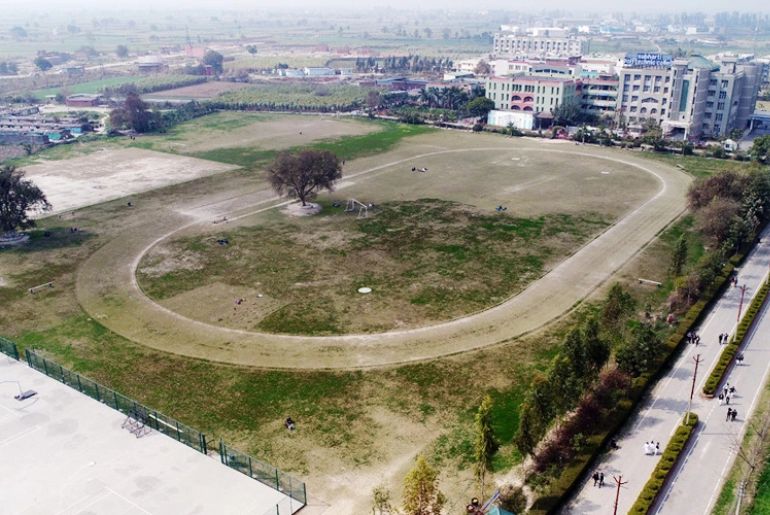
The campus that buzzes with energy, fostering holistic development beyond academics. Most focused teachers are shaping students industry ready.
The University has a vast reservoir of knowledge to demonstrate a high quality placement track record. A temple of practical learning, industry exposure and research opportunities.
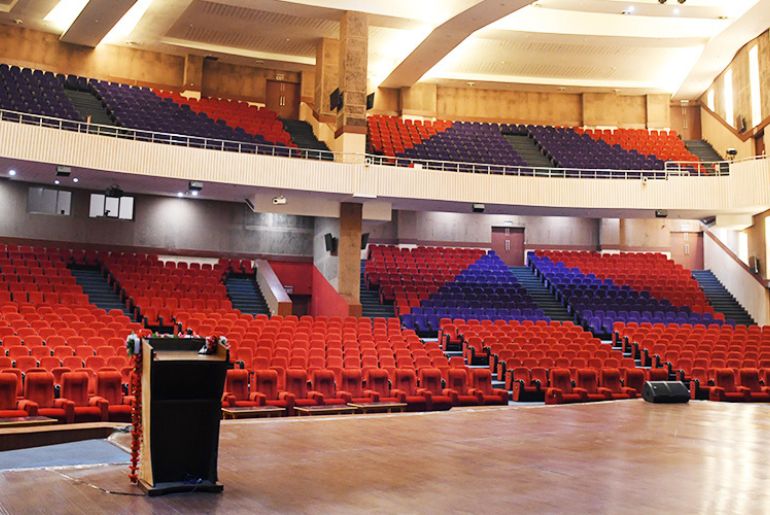
A University with Comprehensive infrastructure, well maintained equipment/ Labs providing students a conducive environment, creative, practical and productive learning.
.jpg)





.png)