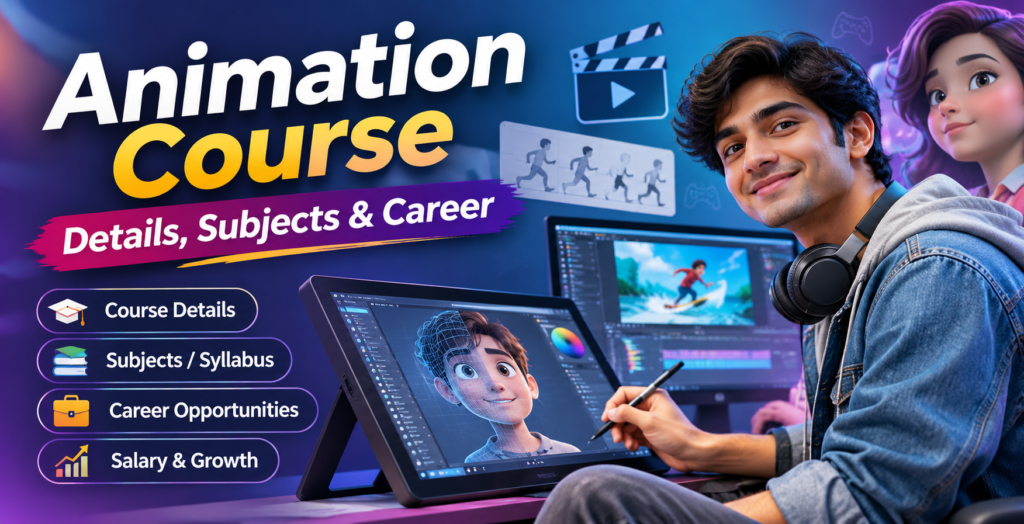

Animation is no longer just about Saturday morning cartoons; it is the visual backbone of the modern media, entertainment, and digital communication landscape. In India, the AVGC (Animation, Visual Effects, Gaming, and Comics) sector is experiencing unprecedented, exponential growth. Yet, with the rapid rise of generative Artificial Intelligence, many aspiring artists and their parents naturally wonder if animation remains a secure and viable career choice.
The answer is a resounding yes. The industry is not shrinking; it is evolving. This comprehensive guide explores the multifaceted world of animation, the transformative (and often misunderstood) impact of AI, and why pursuing formal training in this field is more relevant than ever for building a highly rewarding career.
What is Animation?
At its absolute core, animation is the art of bringing the inanimate to life. It is the complex process of photographing successive drawings, 3D models, or physical puppets to create an optical illusion of movement in a sequence. By displaying these static images rapidly—typically at 24 to 60 frames per second—the human eye perceives continuous, fluid motion.
However, true animation goes far beyond moving an object from point A to point B. It blends artistic expression with technical precision. An animator must possess a deep understanding of real-world physics, anatomy, weight, and timing, all while acting through their characters to deliver emotional depth and narrative storytelling. It is the art of making an audience care about a cluster of pixels or a pencil sketch.
How Animation Compares with Other Similar Disciplines
To truly understand the scope of an animator’s job, it helps to distinguish it from its close cousins in the visual and media arts:
Graphic Design: Graphic design is the art of static visual communication. Designers focus on typography, color theory, and layout to create logos, posters, and brand identities that convey a specific message instantly. Animators, by contrast, focus on the dimension of time, sequencing, and movement over a duration.
Visual Effects (VFX): VFX involves integrating live-action cinematic footage with computer-generated imagery (CGI). VFX artists create environments, explosions, or digital creatures that are too dangerous, expensive, or impossible to capture on a physical set. While VFX artists enhance reality to make the impossible look real, animators often create entirely new realities from scratch. However, in modern filmmaking, the two fields frequently overlap.
Illustration: Illustrators create single, impactful images to accompany text, convey a concept, or tell a story in one definitive frame. Animators, on the other hand, must draw or manipulate a character’s pose thousands of times to create a cohesive performance.
Live-Action Filmmaking: Live-action relies on human actors, physical sets, and real-world cameras. Animation offers the director infinite control—every single blade of grass, the exact angle of the lighting, and the slightest facial twitch of a character is meticulously designed and placed by the artist.
Types of Animation
The animation industry is not a monolith. It spans several distinct mediums, each requiring highly specialized skills and software:
2D Animation: The traditional method of drawing frame-by-frame. While historically done on paper, modern 2D animation is entirely digitized using software like Toon Boom Harmony and Adobe Animate. This style is experiencing a massive resurgence through regional web series, global anime consumption, and independent filmmaking.
3D Animation: The dominant force in modern cinema and interactive gaming. Artists build digital models (characters, vehicles, environments) and manipulate them in a three-dimensional virtual space using industry-standard tools like Autodesk Maya, Blender, and Cinema 4D.
Motion Graphics: Focusing on moving text, shapes, and graphic elements, this style is heavily used in digital advertising, corporate explainer videos, television broadcasting, and user interface (UI) animations.
Stop Motion: A highly tactile, labor-intensive process involving physical models (like clay figures or puppets) that are moved in microscopic increments and photographed frame-by-frame.
Why an Animation Course is Still Highly Relevant
With AI tools becoming so accessible, one might assume that formal education is no longer necessary. The reality is the exact opposite. AI tools only produce professional-grade results when the animator using them already fundamentally understands timing, weight, visual appeal, and cinematic storytelling. Without that core artistic foundation, AI output looks fundamentally wrong—and an untrained operator will not know why it looks wrong, let alone how to fix it.
A structured animation course teaches these timeless fundamentals. In 2026, leading Indian institutes approach AI as a creative accelerator rather than a shortcut. Formal education provides crucial access to industry-standard production pipelines, peer collaboration, and mentorship. More importantly, it helps students build a robust, polished showreel—which studios weigh far more heavily than a standard resume or a formal degree alone. Studios today are actively hunting for professionals who have the baseline knowledge to troubleshoot AI outputs and lead the creative process, rather than just act as software operators.
Course Details & Curriculum
A comprehensive education in animation—whether a B.Sc. in Animation, a Bachelor of Fine Arts (Animation), or an advanced professional diploma—is rigorously designed to build both artistic sensibilities and technical mastery. A modern Indian curriculum generally follows a progressive structure:
Foundation (The Art of Animation): Before touching a computer, students master art fundamentals. Subjects include life drawing, human anatomy, color theory, storyboarding, character design, and the foundational “12 Principles of Animation.”
Technical Mastery (The Software): Students are introduced to industry-standard software. They learn 2D digital animation (Adobe Animate, Toon Boom), 3D modeling, texturing, lighting, and basic rigging using Autodesk Maya and Blender.
Specialization & Advanced Tools: As students progress, they choose specific tracks such as 3D character animation, VFX, or game design. The curriculum incorporates simulation tools like Houdini for FX-heavy roles, compositing software like Nuke or After Effects, and real-time rendering engines like Unreal Engine.
AI & Modern Pipelines: Modern curriculums actively integrate training in AI-assisted workflows (e.g., Runway ML, Adobe Firefly, and AI features native to Maya/Blender). This ensures graduates are employable and fluent in the production environments actually used in 2026.
Portfolio & Showreel Development: The culmination of the course is the creation of a professional portfolio showcasing 3 to 5 highly polished pieces that demonstrate creative problem-solving and technical execution in the student’s chosen niche.
Why Choose Animation as a Career Option
India is undergoing a media revolution. The nation is no longer just consuming animated content; it is a global powerhouse producing it for the world.
Massive Economic Growth: The Indian media and entertainment sector is projected to reach an astounding ₹3.3 lakh crore by 2028, with animation and VFX acting as key, undeniable growth drivers. Furthermore, the Indian animation segment alone is projected to grow to nearly ₹13,800 crore by 2028.
Government Support: The Indian government’s backing through the AVGC-XR policy recognizes the sector as a massive job creator, highly labor-intensive, and inherently skill-driven.
A Global Hub: India remains a premium destination for global outsourcing. International studios consistently outsource high-end VFX and animation work to Indian teams due to the high quality of work, competitive costs, and English proficiency.
Geographical Freedom: The industry is no longer confined to major metros like Mumbai or Bengaluru. With cloud rendering, remote production pipelines, and studio expansions, animators are increasingly building successful careers from Tier-2 and Tier-3 cities like Amritsar, Chandigarh, and Ludhiana.
Limitless Demand: From Netflix and Amazon Prime investing heavily in regional animated shows, to the booming game development sector (growing at a 23% CAGR), to the constant need for motion graphics in EdTech and advertising—the demand for skilled professionals is omnipresent.
Job Prospects & Career Opportunities
The Indian AVGC sector is currently creating over 1.6 lakh new jobs every year, with total sector employment projected to cross 2 million by 2030. This translates into a vibrant, multi-tiered job market with excellent financial trajectories.
Entry-Level (0-2 years): Fresh graduates starting as 2D/3D Animators, Roto/Paint Artists, or Junior Motion Graphics Designers typically see starting salaries between ₹2.5 to ₹5 LPA.
Mid-Level (3-6 years): As artists specialize, gain credits on real production floors, and build speed, salaries scale rapidly to ₹6 to ₹14 LPA. Motion designers and UI/UX animators in the digital advertising and tech startup space often experience incredibly fast salary growth.
Senior Level & Specialists (7+ years): Artists who master their craft and step into leadership roles—such as VFX Supervisors, Animation Directors, or FX Technical Directors building complex simulations in Houdini—command premium salaries ranging from ₹15 LPA to well above ₹35 LPA.
Freelance and Global Opportunities: The remote nature of digital art, combined with AI acting as a productivity multiplier, has lowered the barrier for global freelancing. Indian artists with strong fundamentals and AI workflow fluency regularly work directly with international clients at USD rates, with top freelancers charging anywhere from ₹50,000 to over ₹2,00,000 per project.
Animation as career is a dynamic, technology-driven art form that sits at the thrilling intersection of human imagination and cutting-edge software. While artificial intelligence has successfully automated the tedious and repetitive aspects of the job, it has paradoxically elevated the absolute need for true artists—visionaries who inherently understand storytelling, emotional resonance, and aesthetic appeal.
For creative individuals in India willing to dedicate themselves to mastering both foundational artistic principles and modern, AI-augmented pipelines, animation is far from a fading prospect. It is a highly viable, deeply rewarding, and financially secure career path that allows you to build worlds, shape narratives, and leave a lasting visual legacy.