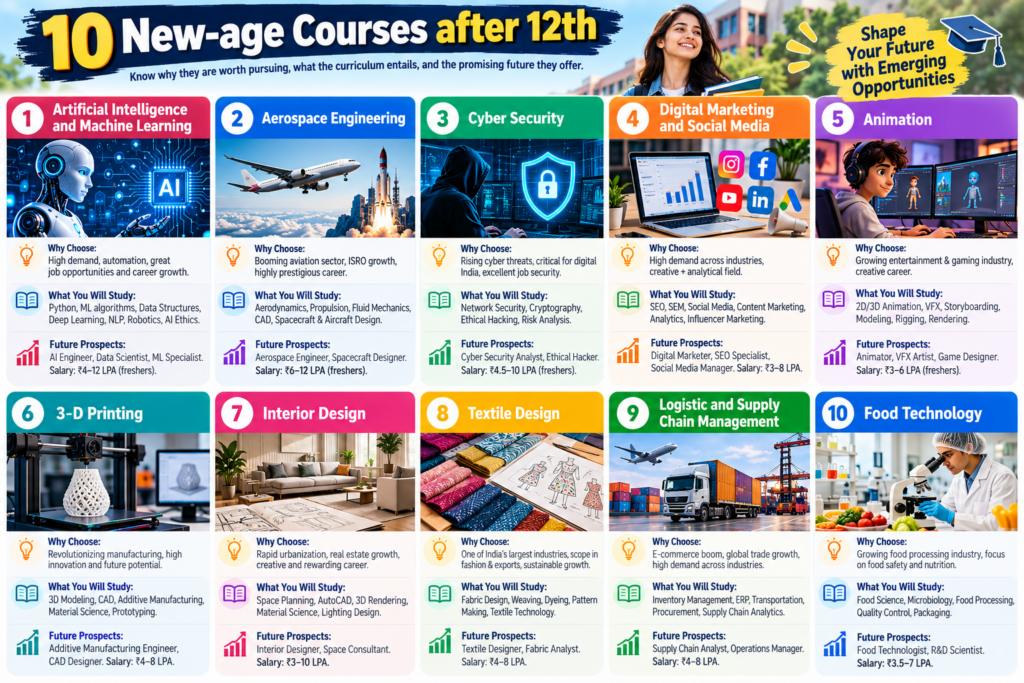

Know why they are worth pursuing, what the curriculum entails, and the promising future they offer.
India is going through a massive digital and technological transformation, making traditional career paths like basic engineering, conventional medical degrees, and plain commerce less of an automatic choice. The rapidly evolving global market, catalyzed by campaigns like Make in India and Digital India, has led to the emergence of highly specialized, new-age career options. For students completing their 12th grade under CBSE, ICSE, or State Boards, the landscape of higher education has changed dramatically. Gone are the days when success was strictly defined by becoming a general physician or a civil engineer. Today’s industries are actively seeking professionals with niche skills who can adapt to rapid technological disruptions and changing consumer behaviors.
The new-age courses are highly interdisciplinary, merging creativity with technology and management with data. They cater to a broad spectrum of interests—from the deeply technical realms of artificial intelligence and aerospace to the creatively driven fields of animation and interior design. Choosing the right course after the 12th standard requires an understanding of one’s aptitudes alongside a sharp awareness of future market trends. The new-age programs focus heavily on practical application, industry internships, and skill-building rather than rote learning.
With India’s booming startup ecosystem and increasing foreign direct investments across sectors, the job prospects for graduates of these modern courses are exceptionally bright, often boasting higher starting salaries and faster career progression than traditional degrees. For students poised at this crucial crossroads of their academic journey, exploring these specialized fields can unlock a world of global opportunities, ensuring they remain relevant in a highly competitive workforce. By stepping beyond conventional boundaries, students can now build resilient careers that align with their true passions.
Below is a detailed look at 10 prominent new-age courses after 12th in India:
1. Artificial Intelligence and Machine Learning
Why Choose It: With India aggressively positioning itself as a global tech hub and businesses universally adopting automation, Artificial Intelligence (AI) and Machine Learning (ML) have become the most sought-after domains. Students should choose this course if they have a strong affinity for mathematics and logical reasoning. AI is no longer just a futuristic concept; it is actively driving the Indian economy—from fintech apps delivering instant loans to agritech startups optimizing crop yields. The demand for skilled professionals drastically outpaces the current supply, ensuring excellent job security and rapid career growth.
What You Will Study: Typically offered as a specialized B.Tech, the curriculum delves deep into the architecture of intelligent systems. Students learn foundational programming languages like Python and R, moving swiftly into complex areas such as algorithms, data structures, neural networks, and deep learning. The coursework also covers Natural Language Processing (NLP), robotics, statistical modeling, and AI ethics. The focus is heavily on hands-on project work, teaching students how to train models to recognize patterns and make autonomous decisions.
Future Prospects: The career prospects in India and abroad are phenomenal. Graduates can step into roles like AI Engineer, Machine Learning Specialist, Data Scientist, or Robotics Programmer. Top recruiters include global tech giants operating in India, such as Google, Microsoft, and Amazon, as well as Indian IT stalwarts and unicorn startups. The starting salaries are among the highest in the technology sector, often ranging from ₹4 LPA to ₹12 LPA as freshers, with experienced professionals commanding significantly more.
2. Aerospace Engineering
Why Choose It: India’s aviation sector is booming, and space exploration has taken a massive leap forward following the successes of ISRO and the privatization of the Indian space industry under the Make in India initiative. Students fascinated by aircraft, spacecraft, and the mechanics of flight will find this field incredibly rewarding. It is a highly specialized branch of engineering that pushes the boundaries of human innovation, making it ideal for those who dream of designing next-generation launch vehicles or sustainable commercial airplanes.
What You Will Study: A B.Tech in Aerospace Engineering is an intensive four-year program. The curriculum combines the principles of mechanical engineering with the specific challenges of atmospheric and space flight. Students rigorously study aerodynamics, fluid mechanics, propulsion systems, thermodynamics, and structural analysis. The coursework involves advanced mathematics and physics, alongside modern computer-aided design (CAD) and simulation software. Students learn how to design, test, and manufacture aircraft, rockets, and satellites, ensuring they can withstand extreme environmental conditions.
Future Prospects: The career trajectory is highly specialized and prestigious. Graduates can work as Aerospace Engineers, Spacecraft Designers, or Maintenance Engineers. In India, prime employers include the Indian Space Research Organisation (ISRO), Defence Research and Development Organisation (DRDO), Hindustan Aeronautics Limited (HAL), and a growing number of private space-tech startups like Skyroot Aerospace. Additionally, commercial airlines like Air India and global manufacturers such as Boeing—which have expanded their engineering centers in India—actively recruit these graduates. Starting salaries range from ₹6 LPA to ₹12 LPA, with rapid escalation as one gains specialized experience.
3. Cyber Security
Why Choose It: As India undergoes rapid digitalization through initiatives like Digital India and the Unified Payments Interface (UPI) revolution, the volume of sensitive data stored online has exploded. Consequently, the threat of cyber-attacks has never been higher. Students should choose Cyber Security if they are analytical, detail-oriented, and enjoy outsmarting complex puzzles. It is a high-stakes, adrenaline-driven career where professionals act as the digital defense mechanism for banks, government databases, and multinational corporations.
What You Will Study: Pursued via a specialized B.Tech in Computer Science or M.Tech in Cyber Security, this course trains students to protect digital networks and data. The curriculum covers a wide array of topics including network security, cryptography, penetration testing, risk analysis, and malware forensics. Students learn to identify vulnerabilities in IT infrastructure and develop robust defense protocols. Hands-on labs simulate real-world cyber-attacks, teaching students how to respond to breaches instantly and secure cloud computing environments.
Future Prospects: The demand for cybersecurity experts is practically recession-proof, as cyber threats continuously evolve. Graduates can secure roles such as Cyber Security Analyst, Ethical Hacker, Security Architect, or Information Security Manager. Top recruiters include major Indian and international banks, IT consultancies, defense agencies, and specialized cybersecurity firms. Starting salaries typically range from ₹4.5 LPA to ₹10 LPA, but professionals acquiring global certifications like CISSP or CEH can see their earning potential multiply rapidly. The constant shortage of skilled security experts in India makes this a highly secure choice.
4. Digital Marketing and Social Media
Why Choose It: In today’s hyper-connected world, businesses in India—from local mom-and-pop stores to massive conglomerates—have realized that their target audience lives online. Traditional marketing has taken a back seat to digital strategies. This course is perfect for creative and analytical minds who understand internet culture and consumer psychology. With the explosive growth of e-commerce and digital content consumption in India, companies are desperate for professionals who can navigate the digital landscape to drive brand growth and sales.
What You Will Study: Offered as MBA specialization or a comprehensive certification course, the curriculum is dynamic and perfectly aligned with current market trends. Students learn the mechanics of Search Engine Optimization (SEO), Search Engine Marketing (SEM), social media strategy, content marketing, and email marketing. A crucial component of the course is data analytics—learning how to interpret consumer data using tools to measure campaign success. Students also explore influencer marketing, paid advertising on platforms like Meta and Google, and digital brand management.
Future Prospects: The career paths are highly diverse and entrepreneurial. Graduates can work as Social Media Managers, SEO Specialists, Performance Marketers, or Digital Strategists. Every industry, including healthcare, entertainment, retail, and tech, requires a digital marketing team. Top employers include digital marketing agencies, e-commerce giants like Flipkart and Amazon, and countless startups. Starting salaries usually range from ₹3 LPA to ₹8 LPA, but the field offers immense freelance and consulting opportunities, allowing successful digital marketers to scale their income significantly.
5. Animation
Why Choose It: India is rapidly emerging as a massive outsourcing hub for global animation and visual effects (VFX) projects, while the domestic gaming and entertainment industry is also experiencing exponential growth. Students with a strong imaginative flair, artistic talent, and a love for storytelling should pursue this course. It breaks away from traditional desk jobs, offering a highly creative environment where one brings characters, environments, and narratives to life. It is the perfect blend of fine arts and cutting-edge digital technology.
What You Will Study: Typically offered as B.Sc. / M.Sc. or Diploma in Animation and Multimedia, the curriculum covers the entire production pipeline. Students begin with the basics of traditional 2D animation, sketching, and storyboarding before moving into complex 3D modeling, rigging, texturing, and rendering. The coursework includes intensive training on industry-standard software. Students also learn about character design, visual effects, lighting, and sound design, usually culminating in a comprehensive portfolio or a short animated film as their final project.
Future Prospects: The Indian animation and VFX industry offers a plethora of exciting roles, including 3D Animator, Storyboard Artist, VFX Supervisor, and Game Designer. Graduates can find lucrative opportunities in film production houses, television networks, advertising agencies, and game development studios. Major global studios often outsource work to Indian firms, creating a steady stream of high-quality jobs. While starting salaries might range from ₹3 LPA to ₹6 LPA, experienced animators with an outstanding portfolio can command exceptionally high pay packages, and many transition into independent creators.
6. 3D Printing
Why Choose It: Also known as Additive Manufacturing, 3-D printing is revolutionizing how physical products are created—from healthcare prosthetics and automotive components to customized fashion. Students who are fascinated by manufacturing, design, and immediate prototyping should strongly consider this niche. As the Make in India initiative pushes for advanced manufacturing capabilities, the Indian market is slowly adopting 3-D printing to reduce material waste and accelerate production. It is a highly innovative field intersecting mechanical engineering, material science, and digital design.
What You Will Study: Often integrated as a specialization within a B.Tech in Mechanical Engineering or offered as a specialized certificate course, the coursework is highly practical. Students study Computer-Aided Design (CAD) and 3-D modeling software to create digital blueprints. The curriculum delves into various additive manufacturing technologies like Fused Deposition Modeling (FDM), Stereolithography (SLA), and Selective Laser Sintering (SLS). Crucially, students learn about material science—understanding the properties of different polymers, resins, and metals used in printing, alongside post-processing techniques and quality control.
Future Prospects: As industries shift towards customized manufacturing, the demand for 3-D printing experts is steadily climbing. Graduates can work as Additive Manufacturing Engineers, Rapid Prototyping Specialists, or CAD Designers. The scope spans multiple sectors: healthcare, aerospace, automotive, and consumer goods. While still a nascent industry in India compared to software, the specialized nature of the skill means less competition and strong demand in forward-thinking manufacturing firms and design labs. Starting salaries generally range from ₹4 LPA to ₹8 LPA, with vast potential for entrepreneurial ventures.
7. Interior Design
Why Choose It: With India’s rapid urbanization, rising disposable incomes, and a booming real estate sector, there is a massive premium placed on well-designed, functional, and aesthetically pleasing spaces. Interior design is no longer just about decoration; it is about optimizing spatial efficiency and enhancing the quality of living and working environments. Students with a keen eye for aesthetics, an understanding of spatial arrangements, and a desire to merge creativity with practical architecture will find this course incredibly fulfilling.
What You Will Study: Offered as a B.Sc. or M.Sc. in Interior Design, the curriculum teaches students how to conceptualize and execute interior spaces for residential, commercial, and hospitality projects. Core subjects include architectural drawing, space planning, material science, and lighting design. Students are heavily trained in digital software like AutoCAD, SketchUp, and 3ds Max to create precise 2D layouts and 3D realistic renders. The course also covers building codes, sustainability practices, and project estimation.
Future Prospects: The career opportunities are vast and highly lucrative for those with a strong portfolio. Graduates can work as Interior Designers, Space Consultants, or Set Designers. They can join established architectural firms, high-end furniture brands, or real estate developers. Starting salaries range from ₹3 LPA to ₹10 LPA, largely depending on the designer’s skill and the firm’s prestige. Furthermore, Interior Design is highly conducive to entrepreneurship; many professionals start their own design studios after gaining a few years of industry experience, drastically increasing their earning potential.
8. Textile Design
Why Choose It: India has a rich, centuries-old heritage of textiles, which is now merging with modern fashion and global export markets. The textile industry is one of the largest contributors to the Indian economy. Students passionate about fabrics, patterns, colors, and sustainable fashion should opt for this course. It is an ideal path for those who want to drive innovation in fashion materials, home furnishings, or even smart textiles, blending India’s traditional craftsmanship with contemporary, eco-friendly manufacturing technologies.
What You Will Study: Pursued through a B.Sc. in Textile Design, the curriculum covers the entire journey of fabric creation. Students study fiber science, yarn manufacturing, weaving, knitting, and printing techniques. The course emphasizes surface embellishment, dyeing methods, and the creation of intricate patterns using both traditional looms and modern digital textile design software. A significant focus is now being placed on sustainable practices, eco-friendly dyes, and the development of technical textiles used in healthcare or sports, ensuring students are ready for the modern market.
Future Prospects: The Indian fashion and textile export market provides robust employment opportunities. Graduates can work as Textile Designers, Fabric Analysts, Color Specialists, or Sourcing Managers. They are heavily recruited by fashion retail brands, garment export houses, home furnishing companies, and boutique design studios. Starting salaries typically range from ₹4 LPA to ₹8 LPA. With the global push towards sustainable and ethical fashion, textile designers from India who understand organic materials and zero-waste production are increasingly in demand on the international stage, opening doors for global careers.
9. Logistic and Supply Chain Management
Why Choose It: The backbone of the modern economy is the seamless movement of goods. With the explosion of e-commerce platforms and quick-commerce startups in India, managing the supply chain has become a highly critical and complex operation. Students who are highly organized, excel at problem-solving, and have a strong analytical mindset should choose this course. It offers a fast-paced career ensuring that global and domestic trade functions efficiently, minimizing costs while maximizing delivery speed.
What You Will Study: Usually offered as a MBA specialization, the curriculum provides a deep dive into operations. Students learn about inventory management, warehouse operations, procurement, transportation logistics, and freight forwarding. The coursework heavily integrates technology, teaching students how to use specialized ERP (Enterprise Resource Planning) software, data analytics, and supply chain modeling to optimize routes and predict demand. It also covers global trade regulations, customs procedures, and the principles of lean management to reduce operational waste.
Future Prospects: This sector is experiencing explosive growth, making it a highly secure career choice. Graduates can take up roles such as Supply Chain Analyst, Logistics Coordinator, Operations Manager, or Procurement Specialist. Major employers include e-commerce giants, third-party logistics providers, manufacturing conglomerates, and FMCG companies. Starting salaries generally fall between ₹4 LPA and ₹8 LPA, but professionals who master supply chain analytics can quickly climb to senior management positions, where compensation packages are extremely competitive and internationally transferable.
10. Food Technology
Why Choose It: India is one of the world’s largest producers of agricultural commodities, yet a significant portion is lost due to inadequate processing and preservation. Food Technology bridges the gap between agriculture and the consumer, focusing on processing, packaging, and food safety. With a growing urban population demanding packaged, ready-to-eat, and health-conscious foods, this industry is expanding rapidly. Students with a strong foundation in biology and chemistry who want to innovate in food nutrition, safety, and sustainable packaging will find this rewarding.
What You Will Study: A B.Tech in Food Technology involves the application of food science to the selection, preservation, processing, and distribution of safe food. The curriculum covers microbiology, food biochemistry, food engineering, and quality control. Students learn how to extend the shelf life of products without losing nutritional value, develop new food products, and design specialized packaging. The course heavily involves laboratory work, teaching students strict adherence to safety standards and regulations set by authorities like FSSAI. Future Prospects: The organized food processing sector in India is receiving massive investments, creating a huge demand for qualified technologists. Graduates can work as Food Quality Managers, R&D Scientists, Production Supervisors, or Regulatory Affairs Specialists. They are highly sought after by multinational FMCG companies, dairy cooperatives, and modern food-tech startups. Starting salaries range from ₹3.5 LPA to ₹7 LPA. With the global shift towards health-centric and sustainable diets, food technologists who innovate in these niches have excellent long-term growth and entrepreneurial potential

